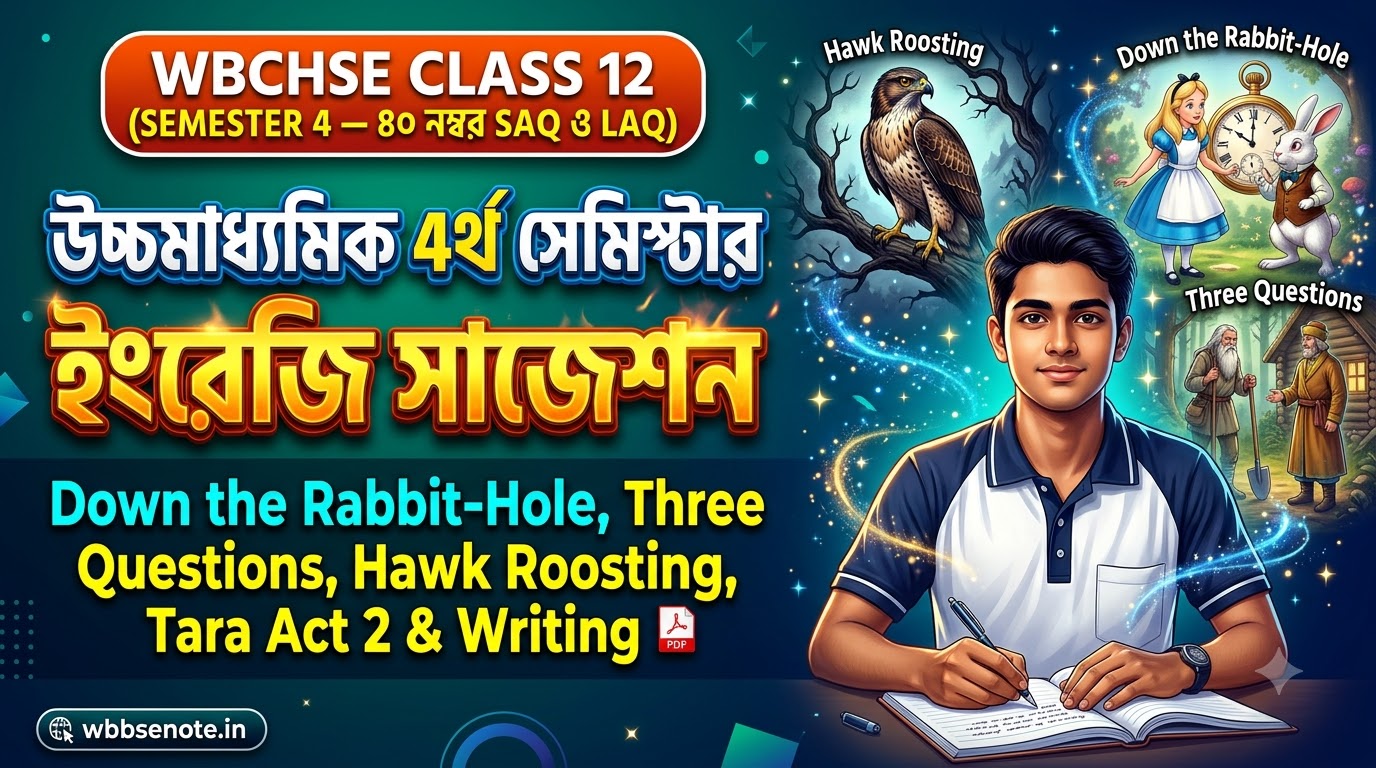
পশ্চিমবঙ্গ উচ্চমাধ্যমিক শিক্ষা সংসদ (WBCHSE)-এর নতুন সেমিস্টার পদ্ধতিতে দ্বাদশ শ্রেণির (Class 12 / HS) চূড়ান্ত লিখিত বোর্ড পরীক্ষা হলো ৪র্থ সেমিস্টার (Semester 4 — ৪০ নম্বরের সংক্ষিপ্ত ও রচনামূলক বা SAQ ও LAQ পরীক্ষা)। সংসদের নতুন পাঠ্যবই ‘A REALM ENGLISH (B) — Class XII, Semester IV’ অনুযায়ী আমাদের এই উচ্চমাধ্যমিক 4র্থ সেমিস্টার ইংরেজি সাজেশন (দ্বাদশ শ্রেণি চতুর্থ সেমিস্টার ইংরেজি সম্পূর্ণ সাজেশন ও WBCHSE Class 12 English Semester 4 Suggestion PDF) আর্টিকেলে আমরা প্রতিটি অধ্যায়—Prose (Alice in Wonderland: ‘Down the Rabbit Hole’ ও Three Questions), Verse (Hawk Roosting, Sonnet 73: ‘That time of year…’ ও The Greenhouse Effect), Play (Tara — Act II), Grammar এবং Writing Skill (Report, Formal Letter, Essay/Blog)-এর বাছাই করা ২, ৫ ও ৬ নম্বরের সম্পূর্ণ আদর্শ উত্তর আলোচনা করেছি।
- উচ্চমাধ্যমিক 4র্থ সেমিস্টার ইংরেজি নতুন সিলেবাস ও নম্বর বিভাজন (WBCHSE Class 12 Semester 4 English Syllabus & Blueprint)
- ১. Unit – I (Prose): ‘Down the Rabbit-Hole’ (Lewis Carroll) ও ‘Three Questions’ (Leo Tolstoy) — SAQ ও ৬ নম্বরের LAQ উত্তর
- A. ২ নম্বরের বাছাই করা সংক্ষিপ্ত প্রশ্ন ও উত্তর (SAQ — 2 Marks Each):
- B. ৬ নম্বরের রচনামূলক প্রশ্ন ও আদর্শ উত্তর (LAQ — 6 Marks):
- ২. Unit – II (Verse): ‘Hawk Roosting’ (Ted Hughes), ‘Sonnet 73’ (Shakespeare) ও ‘The Greenhouse Effect’ (Carl Dennis) — SAQ ও ৬ নম্বরের LAQ উত্তর
- A. ২ নম্বরের বাছাই করা সংক্ষিপ্ত প্রশ্ন ও উত্তর (SAQ — 2 Marks Each):
- B. ৬ নম্বরের রচনামূলক প্রশ্ন ও আদর্শ উত্তর (LAQ — 6 Marks):
- ৩. Unit – III (Play): ‘Tara (Act II)’ — Mahesh Dattani — ৫ নম্বরের নিশ্চিত প্রশ্ন ও আদর্শ উত্তর
- Question 5: What shocking truth does Mr. Patel finally reveal to Tara and Chandan in Act II of Mahesh Dattani’s play ‘Tara’? How does this revelation shatter Tara and lead to the tragic climax of the play? (5 Marks)
- ৪. Unit – IV & V: Grammar & Writing Skill (১৫ নম্বর নিশ্চিত)
- প্রয়োজনীয় স্টাডি মেটেরিয়াল ও পিডিএফ বুক স্টোর লিঙ্ক (Internal Linking Box)
- উচ্চমাধ্যমিক 4র্থ সেমিস্টার ইংরেজি সাজেশন সংক্রান্ত সাধারণ প্রশ্নোত্তর (FAQs)
চতুর্থ সেমিস্টারের সমস্ত অধ্যায়ের টেক্সটবুক সমাধান ও পিডিএফ বইয়ের জন্য আমাদের সাইটের WBCHSE Class 12 Semester 4 A REALM English Textbook Solutions, WBCHSE Class 12 Semester 4 English PDF Book Download এবং বুক স্টোর দ্বাদশ শ্রেণীর চতুর্থ সেমিস্টারের ইংরেজি নোট বই PDF দেখে নিতে পারো।
উচ্চমাধ্যমিক 4র্থ সেমিস্টার ইংরেজি নতুন সিলেবাস ও নম্বর বিভাজন (WBCHSE Class 12 Semester 4 English Syllabus & Blueprint)
দ্বাদশ শ্রেণির ৪র্থ সেমিস্টার ইংরেজি পরীক্ষায় (পূর্ণমান: ৪০, সময়: ২ ঘণ্টা) কোন কোন অধ্যায় পাঠ্য এবং কোন ইউনিট থেকে কত নম্বরের প্রশ্ন আসবে, তার অফিশিয়াল ছক নিচে দেওয়া হলো:
| ইউনিট ও বিভাগ (Syllabus Unit) | নির্ধারিত পাঠ্য রচনা ও লেখক (Prescribed Texts — A REALM Semester 4) | প্রশ্নের ধরন (SAQ & Descriptive LAQ) | নির্ধারিত নম্বর |
| Unit – I: Prose (গদ্য অংশ) | 1. Alice in Wonderland (‘Down the Rabbit-Hole’) — Lewis Carroll ; 2. Three Questions — Leo Tolstoy | SAQ: ২টি (২×২=৪) এবং LAQ: ১টি (১×৬=৬) | ১০ নম্বর |
| Unit – II: Verse / Poetry (কবিতা অংশ) | 1. Hawk Roosting — Ted Hughes ; 2. That time of year… (Sonnet 73) — William Shakespeare ; 3. The Greenhouse Effect — Carl Dennis | SAQ: ২টি (২×২=৪) এবং LAQ: ১টি (১×৬=৬) | ১০ নম্বর |
| Unit – III: Play / Drama (নাটক অংশ) | 1. Tara (Act – II) — Mahesh Dattani | LAQ: ১টি রচনাধর্মী প্রশ্ন (১×৫=৫) | ৫ নম্বর |
| Unit – IV: Grammar | Synthesis, Splitting, Transformation & Error Correction | বর্ণনামূলক গ্রামার প্রশ্ন | ৫ নম্বর |
| Unit – V: Writing Skill | Report Writing / Formal Letter / Blog / Essay Writing | বিকল্পসহ যেকোনো ১টি বা ২টি রাইটিং | ১০ নম্বর |
| সর্বমোট (Total Semester 4) | বর্ণনামূলক লিখিত পরীক্ষা (Descriptive SAQ + LAQ) | পূর্ণমান: ৪০ নম্বর | ৪০ নম্বর |
১. Unit – I (Prose): ‘Down the Rabbit-Hole’ (Lewis Carroll) ও ‘Three Questions’ (Leo Tolstoy) — SAQ ও ৬ নম্বরের LAQ উত্তর
A. ২ নম্বরের বাছাই করা সংক্ষিপ্ত প্রশ্ন ও উত্তর (SAQ — 2 Marks Each):
- Question 1: Why was Alice getting tired of sitting by her sister on the bank, and what was her opinion about her sister’s book? (‘Down the Rabbit-Hole’)
- Answer: Alice was getting very tired of sitting by her sister on the river bank because she had nothing to do. She peeped into the book her sister was reading, but found it boring as it had no pictures or conversations in it, wondering, “What is the use of a book without pictures or conversations?”
- Question 2: What was so remarkable about the White Rabbit that made Alice jump up and follow it down the rabbit-hole? (‘Down the Rabbit-Hole’)
- Answer: While seeing a White Rabbit with pink eyes muttering “Oh dear! Oh dear! I shall be late!” did not seem very strange to Alice at first, when the Rabbit actually took a watch out of its waistcoat-pocket and looked at it before hurrying on, Alice burned with curiosity and followed it down the rabbit-hole.
- Question 3: What was written on the little glass bottle that Alice found on the three-legged glass table, and what happened when she drank it? (‘Down the Rabbit-Hole’)
- Answer: Around the neck of the bottle was a paper label with the words “DRINK ME” beautifully printed on it in large letters. When Alice drank the delicious liquid (which tasted of cherry-tart, custard, pineapple, roast turkey, toffee, and hot buttered toast), she shrank to only ten inches high.
- Question 4: What were the three questions that occurred to the Tsar in Leo Tolstoy’s ‘Three Questions’?
- Answer: The Tsar’s three questions were: (1) What was the right time for every action? (2) Who were the most necessary people to listen to? and (3) What was the most important thing to do at all times?
- Question 5: Why had the bearded man sworn to take revenge on the Tsar, and how was he wounded? (‘Three Questions’)
- Answer: The bearded man was the Tsar’s sworn enemy because the Tsar had executed his brother and seized his property. While hiding in ambush to kill the Tsar on his way back from the hermit, the man was recognized and wounded in the stomach by the Tsar’s bodyguard.
B. ৬ নম্বরের রচনামূলক প্রশ্ন ও আদর্শ উত্তর (LAQ — 6 Marks):
Question 1: Describe Alice’s strange experiences as she fell down the deep rabbit-hole and landed in the long hall lined with locked doors in ‘Down the Rabbit-Hole’. (6 Marks)
Answer (with Point-wise Structure):
- The Sudden Fall into the Well: In Lewis Carroll’s ‘Down the Rabbit-Hole’ (Chapter 1 of Alice’s Adventures in Wonderland), Alice followed the White Rabbit into a tunnel that suddenly dipped straight down like a deep well. Either the well was very deep, or she fell very slowly, giving her plenty of time to look around.
- Strange Objects on the Shelves: As she fell, she noticed that the sides of the well were filled with cupboards, bookshelves, maps, and pictures hung upon pegs. She took down a jar labelled “ORANGE MARMALADE”, found it empty, and carefully placed it into another cupboard as she fell past so as not to kill anyone underneath.
- Daydreaming During the Fall: Alice wondered how many miles she had fallen—perhaps four thousand miles towards the centre of the earth, or whether she would fall right through the earth to the “Antipathies” (Antipodes) among people who walk with their heads downward, and worried about who would feed her cat Dinah at night.
- The Locked Hall and the Tiny Golden Key: Finally, she landed safely on a heap of sticks and dry leaves. She found herself in a long, low hall lit by a row of lamps. All the doors around the hall were locked. On a three-legged solid glass table, she discovered a tiny golden key that unlocked a little fifteen-inch door leading into the loveliest garden she had ever seen, though she was initially too big to pass through it and later forgot the key on the table after shrinking to ten inches.
Question 2: How did the wise hermit finally answer the Tsar’s three questions through the real-life incidents in Leo Tolstoy’s ‘Three Questions’? (6 Marks)
Answer:
- The Tsar’s Visit to the Hermit: Dissatisfied with the conflicting answers of learned scholars, the Tsar dressed in simple clothes and visited a frail old hermit who was digging seed-beds in the woods.
- First Answer (The Most Important Time): The hermit explained that the only time that is truly important is “Now” (the present moment), because it is the only time when we have any power to act. Had the Tsar not pitied the hermit’s weakness and stayed back to dig the beds for him, he would have been attacked by the bearded man on his way back.
- Second Answer (The Most Important Person): The most necessary person is the one with whom you are at a particular moment, for no man knows whether he will ever have dealings with anyone else. Thus, first the hermit, and later the wounded bearded man, were the most important men to the Tsar.
- Third Answer (The Most Important Affair): The most important business of human life is to do good to the person with whom one is, because for that purpose alone was man sent into this life.
২. Unit – II (Verse): ‘Hawk Roosting’ (Ted Hughes), ‘Sonnet 73’ (Shakespeare) ও ‘The Greenhouse Effect’ (Carl Dennis) — SAQ ও ৬ নম্বরের LAQ উত্তর
A. ২ নম্বরের বাছাই করা সংক্ষিপ্ত প্রশ্ন ও উত্তর (SAQ — 2 Marks Each):
- Question 1: Where does the hawk sit at the beginning of Ted Hughes’ ‘Hawk Roosting’, and what does it rehearse in its sleep?
- Answer: The hawk sits at the top of the wood with its eyes closed. Even in sleep, there is no falsifying dream; between its hooked head and hooked feet, it rehearses how to kill and eat convincingly.
- Question 2: What advantages of nature does the hawk claim to have been created solely for its convenience in ‘Hawk Roosting’?
- Answer: In its supreme arrogance, the hawk believes that the high trees, the buoyancy of the air, the sun’s ray, and the earth’s upward face for its inspection are all designed exclusively for its own convenience.
- Question 3: What are the three metaphors of aging used by William Shakespeare in the three quatrains of Sonnet 73 (‘That time of year thou mayst in me behold’)?
- Answer: Shakespeare compares his advancing old age to: (1) late Autumn when yellow leaves, or none, or few hang upon the boughs (“bare ruin’d choirs”), (2) Twilight fading into black night (“Death’s second self”), and (3) the dying embers of a fire consumed on the ashes of its youth.
- Question 4: What gradual changes in global agriculture and superpower status does Carl Dennis predict in ‘The Greenhouse Effect’?
- Answer: Due to the gradual warming trend, grain belts will slide closer to the poles, making the American Plains arid like a desert while Greenland and Siberia become fertile agricultural lands, reducing current superpowers to poor nations like Chad.
B. ৬ নম্বরের রচনামূলক প্রশ্ন ও আদর্শ উত্তর (LAQ — 6 Marks):
Question 3: Critically analyze Ted Hughes’ ‘Hawk Roosting’ as a dramatic monologue depicting raw, ruthless power and totalitarian egoism. (6 Marks)
Answer:
- Introduction: Ted Hughes’ celebrated poem ‘Hawk Roosting’ (from Lupercal, 1960) is a powerful interior monologue spoken by a bird of prey perched at the top of a forest.
- Physical Perfection as a Killing Machine: From its hooked head to its hooked feet locked in the rough bark, every part of the hawk’s anatomy is designed for one single purpose—predation. It takes “the whole of Creation” to produce its foot and each feather.
- Egocentric Supremacy Over Nature: Unlike humans who rely on moral arguments or sophistry, the hawk asserts absolute dominance over creation: “I kill where I please because it is all mine.” Its manners are simply “tearing off heads — The allotment of death.”
- Resistance to Change (Symbol of Dictatorship): The poem concludes with the hawk’s chilling declaration: “Nothing has changed since I began. / My eye has permitted no change. / I am going to keep things like this.” Whether viewed as raw nature devoid of human hypocrisy or as an allegory of a ruthless fascist dictator, the hawk embodies unchallenged, unyielding power.
Question 4: How does Carl Dennis blend ecological warning with subtle irony and human resilience in his poem ‘The Greenhouse Effect’? (6 Marks)
Answer:
- Ecological Premise: In ‘The Greenhouse Effect’, Carl Dennis envisions a future transformed by global warming, where the melting of polar ice and shifting climate zones permanently alter human geography.
- Reversal of Global Power: As the American Midwest turns into dust and desert, once-frozen lands like Greenland and Northern Russia will blossom with wheat and temples. America will lose its superpower status, its suburbs turning into farms tilled by citizens pushing hand-carts because cars will be too expensive.
- Critique of Short-Sighted Greed: The poet ironically notes that people refuse to pay higher taxes today to repair breaking levees or stop pollution, preferring to “let them break” and adapt later when catastrophe strikes.
- Conclusion: While mankind may survive by listening to local bands in the town square and tending oak trees instead of elms, the poem serves as a sobering warning about the irreversible cost of environmental negligence.
৩. Unit – III (Play): ‘Tara (Act II)’ — Mahesh Dattani — ৫ নম্বরের নিশ্চিত প্রশ্ন ও আদর্শ উত্তর
Question 5: What shocking truth does Mr. Patel finally reveal to Tara and Chandan in Act II of Mahesh Dattani’s play ‘Tara’? How does this revelation shatter Tara and lead to the tragic climax of the play? (5 Marks)
Answer (with Point-wise Structure):
- Background of the Conflict: Throughout Act I and early Act II of Mahesh Dattani’s ‘Tara’, the mother Bharati showers obsessive, guilt-ridden affection on Tara (even wanting to donate her own kidney to Tara) while blaming her husband Mr. Patel for Tara’s suffering.
- The Shocking Medical Truth: After Bharati suffers a nervous breakdown and is admitted to a hospital, Mr. Patel finally reveals the dark family secret to Tara and Chandan. When the twins were born conjoined with three legs, medical tests by Dr. Thakkar proved that the blood supply to the third leg came from Tara’s body, meaning the second leg rightfully belonged to Tara.
- The Conspiracy of Gender Bias: However, Bharati and her influential politician father bribed Dr. Thakkar (promising him three acres of prime land in Bangalore) to risk attaching the third leg to the boy, Chandan, so that the male heir would have two complete legs. Ironically, Chandan’s body rejected the leg within two days, and it had to be amputated—leaving both children crippled for life.
- Tragic Climax: Learning that her own beloved mother had deprived her of her rightful leg simply because she was a girl, Tara’s spirit is completely broken. She wastes away and dies prematurely, leaving Chandan (Dan) in London haunted by lifelong guilt, begging his dead sister in the final embrace: “Forgive me, Tara. Forgive me, for making it my tragedy.”
৪. Unit – IV & V: Grammar & Writing Skill (১৫ নম্বর নিশ্চিত)
৪র্থ সেমিস্টারে বর্ণনামূলক গ্রামার (৫ নম্বর) এবং রাইটিং স্কিল (১০ নম্বর — Report Writing / Formal Letter / Blog বা Essay Writing) থাকে। (রাইটিং স্কিলের দুটি আদর্শ উত্তর—Seminar on Safe Use of AI & Cyber Security Report এবং Letter to Principal for Library Books—উপরে ও আমাদের পিডিএফ নোটবুকে দেওয়া আছে)। এ ছাড়া Blog Post Writing (যেমন: Benefits of Digital Literacy / Climate Change and Youth) এবং Essay on Environmental Conservation অবশ্যই দেখে রাখবে।
প্রয়োজনীয় স্টাডি মেটেরিয়াল ও পিডিএফ বুক স্টোর লিঙ্ক (Internal Linking Box)
উচ্চমাধ্যমিক ৩য় ও ৪র্থ সেমিস্টার সমস্ত বিষয়ের সাজেশন ও পিডিএফ বুক ডাউনলোড:
- উচ্চমাধ্যমিক ৪র্থ সেমিস্টার ইংরেজি সব অধ্যায় ও পিডিএফ বুক: WBCHSE Class 12 Semester 4 A REALM English Textbook Solutions | WBCHSE Class 12 Semester 4 English PDF Book Download | দ্বাদশ শ্রেণীর চতুর্থ সেমিস্টারের ইংরেজি নোট বই PDF
- উচ্চমাধ্যমিক ৩য় সেমিস্টার ইংরেজি সব অধ্যায় ও পিডিএফ বুক: WBCHSE Class 12 Semester 3 A REALM English Textbook Solutions | দ্বাদশ শ্রেণীর তৃতীয় সেমিস্টারের ইংরেজি নোট বই PDF
- উচ্চমাধ্যমিক ৩য় ও ৪র্থ সেমিস্টার বাংলা পিডিএফ বুক: দ্বাদশ শ্রেণীর তৃতীয় সেমিস্টারের বাংলা নোট বই PDF | দ্বাদশ শ্রেণীর চতুর্থ সেমিস্টারের বাংলা নোট ও সাজেশন PDF
- উচ্চমাধ্যমিক সেমিস্টার ৪ অল-সাবজেক্ট ক্যাটাগরি হাব: Class 12 Semester 4 (SAQ & LAQ) | উচ্চমাধ্যমিক সাজেশন ২০২৭
উচ্চমাধ্যমিক 4র্থ সেমিস্টার ইংরেজি সাজেশন সংক্রান্ত সাধারণ প্রশ্নোত্তর (FAQs)
প্রশ্ন ১: উচ্চমাধ্যমিক 4র্থ সেমিস্টার ইংরেজি পরীক্ষায় কোন কোন অধ্যায় পাঠ্য রয়েছে? উত্তর: দ্বাদশ শ্রেণির ৪র্থ সেমিস্টারের ‘A REALM ENGLISH (B)’ পাঠ্যবইয়ে রয়েছে ২টি গদ্য (Alice in Wonderland: ‘Down the Rabbit-Hole’ ও Three Questions), ৩টি কবিতা (Hawk Roosting, Shakespeare’s Sonnet 73, এবং The Greenhouse Effect), ১টি নাটক (Tara — Act II), এবং Grammar ও Writing Skill।
প্রশ্ন ২: ৪র্থ সেমিস্টার ইংরেজিতে গদ্য ও কবিতা থেকে কত নম্বরের বড়ো প্রশ্ন লিখতে হয়? উত্তর: গদ্য (Prose) থেকে ২ নম্বরের ২টি SAQ (৪) এবং ৬ নম্বরের ১টি বড়ো প্রশ্ন (৬) = ১০ নম্বর; এবং কবিতা (Verse) থেকেও ২ নম্বরের ২টি SAQ (৪) এবং ৬ নম্বরের ১টি বড়ো প্রশ্ন (৬) = ১০ নম্বর লিখতে হয়।
প্রশ্ন ৩: নাটক ‘Tara (Act II)’ থেকে ৫ নম্বরের জন্য কোন প্রশ্নটি সবচেয়ে বেশি গুরুত্বপূর্ণ? উত্তর: দ্বিতীয় অঙ্কে মিস্টার প্যাটেল কীভাবে তরা ও চন্দনের কাছে তৃতীয় পা-টির অস্ত্রোপচার সংক্রান্ত গোপন সত্যটি প্রকাশ করেন (The revelation of the truth behind the separation surgery) এবং তার ফলে তরার ট্র্যাজিক পরিণতি—এই প্রশ্নটি সবচেয়ে বেশি গুরুত্বপূর্ণ।
প্রশ্ন ৪: কবিতা অংশে ৬ নম্বরের প্রশ্নের জন্য কোন দুটি কবিতা ভালো করে পড়লে কমন পাওয়া যাবে? উত্তর: তিনটি কবিতার মধ্যে টেড হিউজের ‘Hawk Roosting’ এবং কার্ল ডেনিসের ‘The Greenhouse Effect’ (অথবা শেক্সপিয়রের Sonnet 73)—যেকোনো দুটি কবিতা ভালো করে তৈরি করলেই ৬ নম্বরের ১টি প্রশ্ন ১০০% কমন পাওয়া যাবে।
প্রশ্ন ৫: উচ্চমাধ্যমিক ৪র্থ সেমিস্টার ইংরেজির সম্পূর্ণ উত্তরসহ পিডিএফ বই কোথায় পাওয়া যাবে? উত্তর: আমাদের ওয়েবসাইট wbbsenote.in এবং পিডিএফ বুক স্টোর books.wbbsenote.in/product/wbchse-class-12-semester-4-english-notebook-and-sugession-pdf/ থেকে চতুর্থ সেমিস্টারের সম্পূর্ণ ইংরেজি নোটবুক পিডিএফ ডাউনলোড করতে পারবে।