
মাধ্যমিক ইংরেজি গ্রামারের সম্পূর্ণ নোট — Tense, Voice, Narration, Articles, Prepositions, Transformation সব বাংলায় সহজে। উদাহরণ ও Practice সহ। WBBSE 2027।
ভূমিকা
মাধ্যমিক পরীক্ষায় ইংরেজি বিষয়ে Grammar অংশ থেকে উল্লেখযোগ্য নম্বর আসে। অনেক ছাত্রছাত্রী ইংরেজিকে কঠিন মনে করে কারণ Grammar-এর নিয়মগুলো মুখস্থ করতে হয়। কিন্তু সত্যি কথা হলো — Grammar বোঝার বিষয়, মুখস্থ করার নয়।
এই পোস্টে মাধ্যমিক পরীক্ষার জন্য সবচেয়ে গুরুত্বপূর্ণ Grammar topics — Tense, Voice Change, Narration Change, Articles, Prepositions এবং Transformation of Sentences — সব কিছু বাংলায় সহজ ভাষায় উদাহরণ সহ ব্যাখ্যা করা হয়েছে।
প্রতিটি rule-এর পর Practice exercise দেওয়া আছে। নিজে সমাধান করার চেষ্টা করো — Grammar শেখার সবচেয়ে ভালো উপায় হলো practice।

অংশ ১ — Tense (কাল)
Tense কী?
Verb-এর যে রূপ থেকে ক্রিয়া সম্পাদনের সময় বোঝা যায় তাকে Tense বলে। ইংরেজিতে তিন ধরনের Tense — Present, Past এবং Future। প্রতিটির আবার চারটি করে রূপ আছে।
Present Tense — সব রূপ
Simple Present Tense:
কাজটি বর্তমানে সাধারণত করা হয় বা সত্যটি চিরন্তন এমন বোঝাতে।
Structure: Subject + V¹ (s/es) + Object
নিয়ম: Third person singular subject-এ (He/She/It/Name) verb-এ s বা es যোগ হয়।
উদাহরণ:
- I go to school every day. (আমি প্রতিদিন স্কুলে যাই)
- She reads books. (সে বই পড়ে)
- The sun rises in the east. (সূর্য পূর্বে ওঠে — চিরন্তন সত্য)
- Water boils at 100°C. (জল ১০০°C-এ ফোটে — বৈজ্ঞানিক সত্য)
Present Continuous Tense:
এই মুহূর্তে কাজটি চলছে এমন বোঝাতে।
Structure: Subject + am/is/are + V¹+ing + Object
উদাহরণ:
- I am reading a book now. (আমি এখন একটি বই পড়ছি)
- They are playing cricket. (তারা ক্রিকেট খেলছে)
- She is cooking dinner. (সে রাতের খাবার রান্না করছে)
Present Perfect Tense:
কাজটি সম্প্রতি শেষ হয়েছে এবং তার ফলাফল এখনও আছে।
Structure: Subject + have/has + V³ + Object
উদাহরণ:
- I have finished my homework. (আমি আমার বাড়ির কাজ শেষ করেছি)
- She has eaten lunch. (সে দুপুরের খাবার খেয়েছে)
- They have gone to Delhi. (তারা দিল্লি চলে গেছে)
Present Perfect Continuous Tense:
কোনো কাজ অতীতে শুরু হয়ে এখনও চলছে।
Structure: Subject + have/has + been + V¹+ing + since/for + Time
উদাহরণ:
- I have been studying for three hours. (আমি তিন ঘণ্টা ধরে পড়ছি)
- She has been living here since 2020. (সে ২০২০ থেকে এখানে থাকছে)

Past Tense — সব রূপ
Simple Past Tense:
নির্দিষ্ট অতীতকালে কাজটি সম্পন্ন হয়েছিল।
Structure: Subject + V² + Object
উদাহরণ:
- I went to school yesterday. (আমি গতকাল স্কুলে গিয়েছিলাম)
- She cooked rice. (সে ভাত রান্না করেছিল)
- He wrote a letter. (সে একটি চিঠি লিখেছিল)
Past Continuous Tense:
অতীতে কোনো নির্দিষ্ট সময়ে কাজটি চলছিল।
Structure: Subject + was/were + V¹+ing + Object
উদাহরণ:
- I was reading when he came. (সে যখন এলো তখন আমি পড়ছিলাম)
- They were playing cricket at 5 pm. (বিকেল ৫টায় তারা ক্রিকেট খেলছিল)
Past Perfect Tense:
অতীতে দুটি কাজের মধ্যে যেটি আগে হয়েছিল।
Structure: Subject + had + V³ + Object
উদাহরণ:
- He had eaten before I arrived. (আমি পৌঁছানোর আগেই সে খেয়ে নিয়েছিল)
- The train had left before we reached the station.
Future Tense — সব রূপ
Simple Future Tense:
ভবিষ্যতে কাজটি হবে।
Structure: Subject + shall/will + V¹ + Object
(I/We-র জন্য shall; He/She/It/They-র জন্য will)
উদাহরণ:
- I shall go to school tomorrow. (আমি আগামীকাল স্কুলে যাব)
- She will cook rice. (সে ভাত রান্না করবে)
Future Continuous Tense:
ভবিষ্যতে কোনো নির্দিষ্ট সময়ে কাজটি চলতে থাকবে।
Structure: Subject + shall/will + be + V¹+ing + Object
উদাহরণ:
- I shall be reading at 8 pm. (রাত ৮টায় আমি পড়ছিব)
Tense Practice Exercise
নিচের বাক্যগুলো সঠিক tense-এ লেখো:
১. সে (go) to school every day.
২. I (read) a book now.
৩. She (eat) lunch already.
৪. He (write) a letter when I called.
৫. The train (leave) before we arrived.
উত্তর: ১. goes ২. am reading ৩. has eaten ৪. was writing ৫. had left
অংশ ২ — Voice Change (কর্তৃবাচ্য থেকে কর্মবাচ্য)
Voice Change কী?
Active Voice-এ কর্তা কাজটি করে এবং Passive Voice-এ কর্তার উপর কাজটি হয়।
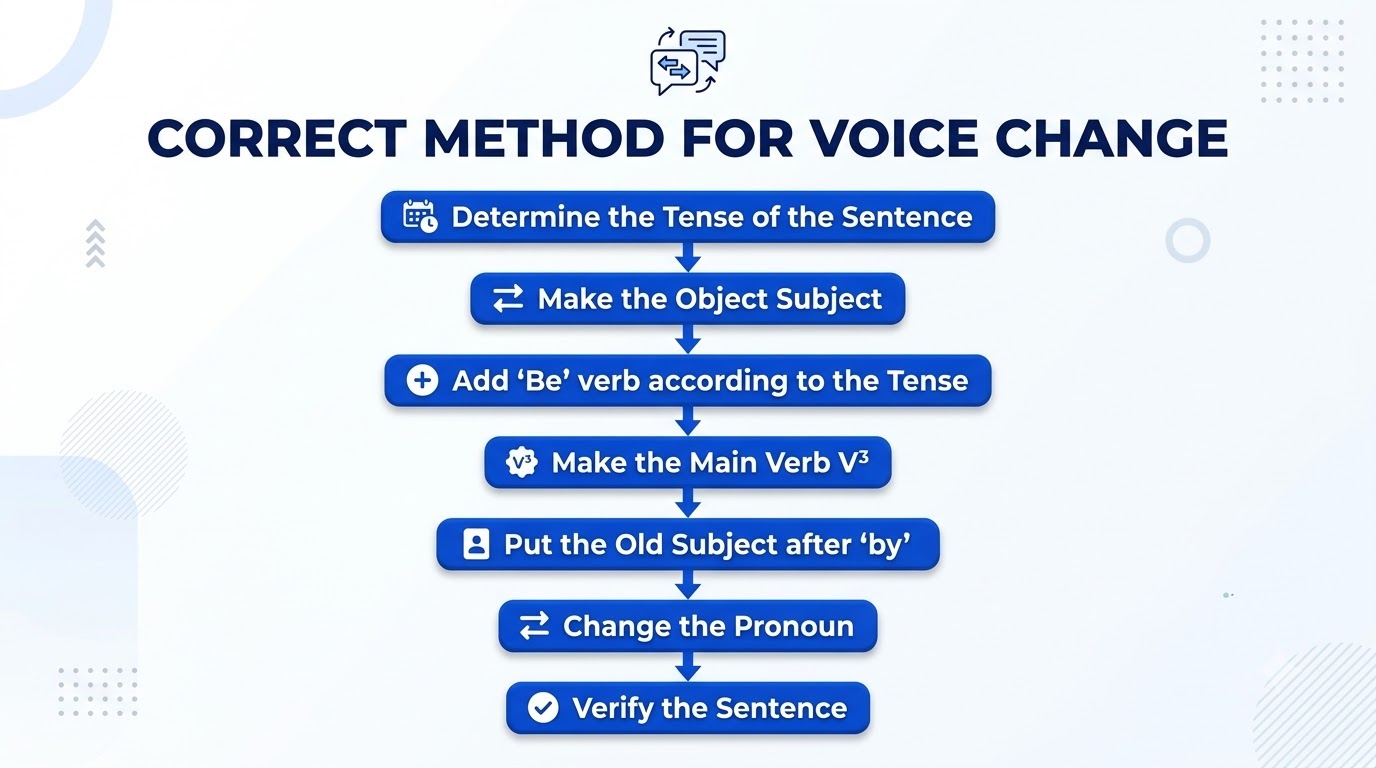
মূল নিয়ম:
Active: Subject + Verb + Object
Passive: Object → Subject + Be verb + V³ + by + (পূর্বের Subject)
Tense অনুযায়ী Voice Change
Simple Present Tense:
Active: Subject + V¹(s/es) + Object
Passive: Object + is/am/are + V³ + by + Subject
উদাহরণ:
- Active: Rima writes a letter. (রিমা চিঠি লেখে)
- Passive: A letter is written by Rima. (রিমার দ্বারা চিঠি লেখা হয়)
Present Continuous Tense:
Active: Subject + is/am/are + V¹+ing + Object
Passive: Object + is/am/are + being + V³ + by + Subject
উদাহরণ:
- Active: She is reading the book.
- Passive: The book is being read by her.
Present Perfect Tense:
Active: Subject + have/has + V³ + Object
Passive: Object + have/has + been + V³ + by + Subject
উদাহরণ:
- Active: I have finished the work.
- Passive: The work has been finished by me.
Simple Past Tense:
Active: Subject + V² + Object
Passive: Object + was/were + V³ + by + Subject
উদাহরণ:
- Active: Ram killed Ravan. (রাম রাবণকে মারল)
- Passive: Ravan was killed by Ram. (রামের দ্বারা রাবণ মারা গেল)
Simple Future Tense:
Active: Subject + shall/will + V¹ + Object
Passive: Object + shall/will + be + V³ + by + Subject
উদাহরণ:
- Active: She will cook rice tomorrow.
- Passive: Rice will be cooked by her tomorrow.
Voice Change-এ Pronoun পরিবর্তন
| Active Subject | Passive Object (by-phrase-এ) |
|---|---|
| I | me |
| We | us |
| He | him |
| She | her |
| They | them |
| You | you |
| It | it |
উদাহরণ:
- Active: I love her. → Passive: She is loved by me.
- Active: He saw them. → Passive: They were seen by him.
Voice Change Practice
নিচের বাক্যগুলো Passive-এ রূপান্তর করো:
১. Ram writes a letter. (Simple Present)
২. She is cooking rice. (Present Continuous)
৩. They have done the work. (Present Perfect)
৪. The teacher punished the boy. (Simple Past)
৫. We shall complete the project. (Simple Future)
উত্তর:
১. A letter is written by Ram.
২. Rice is being cooked by her.
৩. The work has been done by them.
৪. The boy was punished by the teacher.
৫. The project will be completed by us.
অংশ ৩ — Narration Change (উক্তি পরিবর্তন)
Narration Change কী?
কেউ কিছু বললে সেটা দুভাবে বলা যায়। তার হুবহু কথা বললে Direct Narration। নিজের ভাষায় বললে Indirect Narration।
মূল নিয়ম:
১. Reporting verb পরিবর্তন
২. Inverted commas তুলে দাও
৩. Conjunction যোগ করো
৪. Pronoun পরিবর্তন করো
৫. Tense পরিবর্তন করো
Statement (Assertive) Narration Change
Reporting verb “said to” → “told”
Conjunction: that
উদাহরণ:
- Direct: He said to me, “I am well.”
- Indirect: He told me that he was well.
Tense পরিবর্তনের নিয়ম:
| Direct (Inverted Commas-এ) | Indirect |
|---|---|
| Simple Present → | Simple Past |
| Present Continuous → | Past Continuous |
| Present Perfect → | Past Perfect |
| Simple Past → | Past Perfect |
| shall/will → | should/would |
| can → | could |
| may → | might |
উদাহরণ:
- Direct: She said, “I am reading a book.”
- Indirect: She said that she was reading a book.
- Direct: He said, “I have done the work.”
- Indirect: He said that he had done the work.
Interrogative Narration Change (প্রশ্নবোধক বাক্য)
Reporting verb: “asked” বা “enquired”
Yes/No প্রশ্নের জন্য: Conjunction: whether / if
উদাহরণ:
- Direct: She said to me, “Are you well?”
- Indirect: She asked me whether/if I was well.
Wh-প্রশ্নের জন্য: Wh-word নিজেই conjunction হিসেবে কাজ করে
উদাহরণ:
- Direct: He said to her, “Where do you live?”
- Indirect: He asked her where she lived.
- Direct: She said, “What is your name?”
- Indirect: She asked what his/her name was.
Imperative Narration Change (আদেশ বা অনুরোধ)
Reporting verb: “told”, “ordered”, “requested”, “advised”, “forbade”
আদেশ: told + to + V¹
উদাহরণ:
- Direct: The teacher said to the student, “Open the book.”
- Indirect: The teacher told the student to open the book.
নিষেধ: told + not + to + V¹
উদাহরণ:
- Direct: Mother said to me, “Don’t play in the sun.”
- Indirect: Mother told me not to play in the sun.
অনুরোধ: requested + to + V¹
উদাহরণ:
- Direct: He said to me, “Please help me.”
- Indirect: He requested me to help him.
Narration Practice
নিচের বাক্যগুলো Indirect-এ রূপান্তর করো:
১. He said to me, “I am going to school.”
২. She said, “I have finished my work.”
৩. Father said to me, “Are you hungry?”
৪. The teacher said, “Where were you yesterday?”
৫. She said to him, “Please give me a glass of water.”
উত্তর:
১. He told me that he was going to school.
২. She said that she had finished her work.
৩. Father asked me whether/if I was hungry.
৪. The teacher asked where he/she had been the previous day.
৫. She requested him to give her a glass of water.
অংশ ৪ — Articles (a, an, the)
Articles কী?
Article হলো Noun-এর আগে বসে Noun-কে নির্দিষ্ট বা অনির্দিষ্ট করে। তিনটি Article — a, an (Indefinite) এবং the (Definite)।
“a” ব্যবহারের নিয়ম
Consonant sound দিয়ে শুরু হওয়া শব্দের আগে “a” ব্যবহার হয়।
উদাহরণ: a book, a cat, a university (u-র উচ্চারণ ‘yu’, consonant sound), a European (E-র উচ্চারণ ‘y’), a one-eyed man (one-এর উচ্চারণ ‘w’)।
“an” ব্যবহারের নিয়ম
Vowel sound (a, e, i, o, u) দিয়ে শুরু হওয়া শব্দের আগে “an” ব্যবহার হয়।
উদাহরণ: an apple, an egg, an umbrella, an honest man (h নিঃশব্দ, তাই vowel sound), an hour (h নিঃশব্দ), an MBA.
“the” ব্যবহারের নিয়ম
“the” নির্দিষ্ট কিছু বোঝাতে ব্যবহার হয়।
কোনো কিছু একমাত্র হলে: the sun, the moon, the earth
আগে উল্লেখিত বিষয়ে: I saw a dog. The dog was black.
সুপারলেটিভ degree-র আগে: He is the best student.
নদী, সমুদ্র, পর্বতশ্রেণীর আগে: the Ganga, the Pacific, the Himalayas
জাতির নামের আগে: the Indians, the Chinese
যন্ত্রপাতির নামের আগে: play the guitar, play the piano
Article ব্যবহার হয় না কখন
Proper Noun-এর আগে সাধারণত article হয় না: Ram, India, Kolkata।
Abstract Noun-এর আগে সাধারণত article হয় না: Honesty is the best policy।
Plural Common Noun (সাধারণ অর্থে) এর আগে article হয় না: Dogs are faithful animals।
Meal এর নামের আগে article হয় না: We have breakfast at 8.
Articles Practice
নিচের শূন্যস্থান পূরণ করো (a / an / the / X):
১. She is ___ honest girl.
২. ___ sun rises in the east.
৩. I have ___ umbrella.
৪. He plays ___ guitar.
৫. ___ Ganga is ___ sacred river.
৬. We eat ___ lunch at 1 pm.
উত্তর: ১. an ২. The ৩. an ৪. the ৫. The, a ৬. X (no article)
অংশ ৫ — Transformation of Sentences
Simple থেকে Complex Sentence
Simple Sentence-এ একটি Subject ও একটি Finite Verb থাকে। Complex Sentence-এ একটি Main Clause এবং এক বা একাধিক Subordinate Clause থাকে।
Noun Clause (that দিয়ে):
- Simple: I know his name.
- Complex: I know that his name is Ramesh.
Adverb Clause (time, condition, reason):
- Simple: Being ill, he could not come. (কারণ)
- Complex: As he was ill, he could not come.
- Simple: Walking fast, he caught the train. (সময়)
- Complex: When he walked fast, he caught the train.
Adjective Clause (who, which, that):
- Simple: I know a man living in Delhi.
- Complex: I know a man who lives in Delhi.
Affirmative থেকে Negative Sentence
কিছু শব্দ ব্যবহার করে অর্থ না পালটে Affirmative থেকে Negative করা যায়।
“only” → “none but” / “nothing but”:
- Affirmative: Only a fool will do this.
- Negative: None but a fool will do this.
“as soon as” → “no sooner…than”:
- Affirmative: As soon as he came, she left.
- Negative: No sooner had he come than she left.
Comparative degree ব্যবহার করে:
- Affirmative: He is the best player.
- Negative: No other player is as good as him. (অথবা) No other player is better than him.
Degree of Comparison পরিবর্তন
Positive থেকে Comparative:
- Positive: Rahim is as tall as Karim.
- Comparative: Karim is not taller than Rahim.
Superlative থেকে Comparative:
- Superlative: Dhaka is the largest city in Bangladesh.
- Comparative: Dhaka is larger than any other city in Bangladesh.
Superlative থেকে Positive:
- Superlative: Iron is the most useful metal.
- Positive: No other metal is as useful as iron.
অংশ ৬ — Writing Section
Letter Writing
Formal Letter Format:
[তোমার ঠিকানা]
[তারিখ]
To,
The Principal/The Editor/The Manager,
[প্রাপকের পদবি ও ঠিকানা]
Subject: [চিঠির বিষয়]
Sir/Madam,
[প্রথম paragraph: চিঠি লেখার উদ্দেশ্য]
[দ্বিতীয় paragraph: মূল বিষয়]
[তৃতীয় paragraph: অনুরোধ বা সিদ্ধান্ত]
Yours faithfully/Yours truly,
[তোমার নাম]
গুরুত্বপূর্ণ Formal Letter বিষয়:
Principal-কে অনুপস্থিতির ছুটির জন্য আবেদন, সম্পাদককে পরিবেশ দূষণ সম্পর্কে চিঠি, Post Master-কে হারানো জিনিস সম্পর্কে চিঠি।
Paragraph Writing
ভালো paragraph লেখার নিয়ম: Topic sentence দিয়ে শুরু করো, তারপর বিস্তারিত ব্যাখ্যা করো এবং Concluding sentence দিয়ে শেষ করো। প্রতিটি paragraph-এ ৮-১০টি বাক্য লেখো।
সচরাচর জিজ্ঞাসা (FAQ)
প্রশ্ন: Voice Change-এ “by” সবসময় ব্যবহার করতে হবে?
উত্তর: না। যদি কর্তা অজানা বা অপ্রয়োজনীয় হয় তাহলে “by + Agent” বাদ দেওয়া যায়। যেমন: “Rice is eaten in Bengal” — এখানে “by us/by people” না লিখলেও চলে।
প্রশ্ন: Narration-এ সব সময় Tense পরিবর্তন করতে হবে?
উত্তর: না। যদি Reporting verb বর্তমান কালে থাকে (says, tells) তাহলে Tense পরিবর্তন হয় না। Universal truth-ও পরিবর্তন হয় না।
প্রশ্ন: “a” ও “an”-এর পার্থক্য কীভাবে বুঝব?
উত্তর: শব্দটি কীভাবে উচ্চারিত হয় সেটা দেখো, বানান নয়। “University” বানানে vowel দিয়ে শুরু কিন্তু উচ্চারণ “yu” (consonant sound) তাই “a university” হবে।
আরও পড়ো: [মাধ্যমিক ইংরেজি Writing Skills] | [মাধ্যমিক ইংরেজি Seen Passage] | [মাধ্যমিক ইংরেজি MCQ]





1 thought on “মাধ্যমিক ইংরেজি গ্রামার সম্পূর্ণ নোট ২০২৭ | Class 10 English Grammar WBBSE | WBBSE Madhyamik English Suggestion 2027”